Starting June 1, voluntary insurance contributions can be paid via the Baraka app
08.06.2026
If you do not have official employment, you can still receive maternity or sickness benefits. To qualify, you must be making regular voluntary social insurance contributions. Additionally, you must meet certain conditions specified by law. You can learn more about these conditions and the payment procedure in this article.
Starting from 2026, a new state social insurance system has been introduced in Uzbekistan. It protects citizens from losing their income during difficult life situations such as illness, pregnancy, and unemployment. Under the new system, benefits are no longer paid at the employer’s expense, but through the State Social Insurance Fund. This ensures equal social guarantees for all citizens working in both the public and private sectors.
You can benefit from 3 types of insurance
In accordance with Decree No. UP-206 of the President of the Republic of Uzbekistan, dated November 3, 2025, the following benefits are designated to be paid through the State Social Insurance Fund:
- From January 1, 2026: Maternity benefit — paid to women for the prenatal and postnatal periods;
- From July 1, 2026: Temporary disability (sick leave) benefit — paid for the period during which employees are unfit for work due to illness;
- From 2030: Severance pay — paid upon the termination of an employee’s contract.
Who is entitled to receive temporary disability and maternity benefits?
- All individuals covered by mandatory state social insurance who possess a valid insurance track record (length of service):
- Those working under an official employment contract with an employer;
- Individuals providing services (performing work) under a civil law contract;
- Those engaged in other official employment activities in accordance with the procedure established by law.
- Individuals covered by state social insurance on a voluntary basis:
- Self-employed individuals;
- Individuals employed in Dehkan (small-scale personal) farms;
- Owners of private plots of land or their family members engaged in work on these plots;
- Citizens of the Republic of Uzbekistan working in organizations established abroad by state bodies and other organizations;
- Citizens of the Republic of Uzbekistan employed abroad under hire;
- Foreign citizens and stateless persons permanently residing in the Republic of Uzbekistan and carrying out income-generating activities within the country;
- Non-working citizens, provided that their insurance contributions are paid by their spouse;
- Citizens receiving income as founders (participants) of legal entities;
- Individual entrepreneurs, including artisans who are members of the “Hunarmand” Association;
- Family members conducting business in the form of a family enterprise without establishing a legal entity;
- The head of a Dehkan farm.
What are the minimum track record (length of service) requirements to receive insurance benefits?
- For maternity benefit: At least 10 months of insurance track record is required (with the last 6 months being continuous);
- For temporary disability benefit: At least 6 months of insurance track record is required.
Are separate contributions paid for maternity benefit and temporary disability benefit? No, the paid insurance contribution covers both. In other words, you make a single payment, and that contribution entitles you to receive both the maternity benefit and the temporary disability benefit.
For voluntary insurance, the minimum monthly contribution starts from 63,550 UZS (5% of the Minimum Wage), and you can pay as much more as you wish, as no upper limit has been set.
Starting June 1, you can pay your voluntary social insurance contributions via the Baraka app. The money will be credited directly to your Baraka social card or bank card.
For how long should the voluntary contributions for maternity and temporary disability benefits be paid? Insurance benefits are allocated based on the citizens’ insurance track record. A citizen who has paid voluntary insurance contributions in higher amounts, regularly, and over a long period will be granted a higher benefit amount in proportion to their insurance track record. At the same time, for individuals insured on a voluntary basis, the maternity benefit is capped at an amount not exceeding five times the minimum wage.
If a citizen has paid insurance on a voluntary basis, how does the benefit amount calculated for maternity leave differ from the benefit paid for temporary disability?
For individuals insured on a voluntary basis, the calculation methodology for both benefits is identical, being based on the days of leave and the average monthly wage:
- Maternity benefit is capped at a maximum of 5 times the minimum wage.
- Temporary disability benefit is calculated based on the days of release from work (leave days) specified in the temporary disability certificate, but it cannot exceed a total of 182 days within a single calendar year.
Which categories of individuals without official employment are eligible to receive sickness benefits?
Starting July 1, 2026, if voluntary insurance contributions are paid for non-working spouses (husband/wife) and citizens who receive income as founders (participants) of legal entities, they may also be granted benefits when admitted to sanatoriums and wellness resorts, or to rehabilitation centers for prosthetics (fitting artificial limbs/organs).
However, benefits are not paid for just any type of illness. They can only receive benefits in the following two situations:
- When undergoing treatment at sanatoriums and wellness resorts upon a doctor’s recommendation;
- When admitted to specialized rehabilitation centers for prosthetics (fitting artificial limbs/organs).
If a citizen who has paid voluntary insurance contributions falls ill, for how long can they receive money from the fund?
For individuals insured on a voluntary basis (who do not have an employer), the first 5 days of illness are unpaid — the benefit is granted starting from the 6th day.
The benefit is paid for the duration of the illness — meaning for as many days as the sick leave certificate is issued (excluding the first 5 days), based on the individual’s insurance track record:
- If the insurance track record is from 6 months to 8 years → 60% of the average wage;
- If the insurance track record is over 8 years → 80% of the average wage.
How much benefit is paid to a citizen who has made voluntary insurance contributions?
For individuals covered by state social insurance on a voluntary basis, the calculation is made by converting the voluntarily paid monthly insurance contributions into a monthly wage. In accordance with this sub-clause, the monthly wage amount starting from January 1, 2026, is determined by dividing the monthly paid insurance contribution amount by the insurance contribution rate applicable at the time of payment, and multiplying the result by 100%.
Example: An insured individual, as a self-employed person, voluntarily paid an insurance contribution of 150,000 UZS to the Fund for January 2026. When calculating the benefit for this citizen, their wage for January 2026 is determined to be 3,000,000 UZS.
The monthly wage amount is calculated as follows: Paid insurance contribution (one hundred and fifty thousand) ÷ Insurance contribution rate (the insurance contribution rate for 2026 is 5%) × 100% = 3,000,000 UZS.
The monthly wage amount determined through this formula is taken into account as the average monthly wage of the insured person for whom the benefit is being calculated.
Download the Baraka app and pay your voluntary social insurance contributions. Protect yourself socially.
Download the app.
You can learn more details about the procedure and payment for maternity benefits here.
More news

Use your sports passport through the “Baraka” app!
Use your sports passport through the “Baraka” app! Now, the digital version of the sports passport—an essential official document...
02.10.2026
ATTO tariffs are now on the Baraka card!
Pay for public transport using your Baraka card and enjoy the exact same transfer discounts as ATTO within 1...
26.06.2026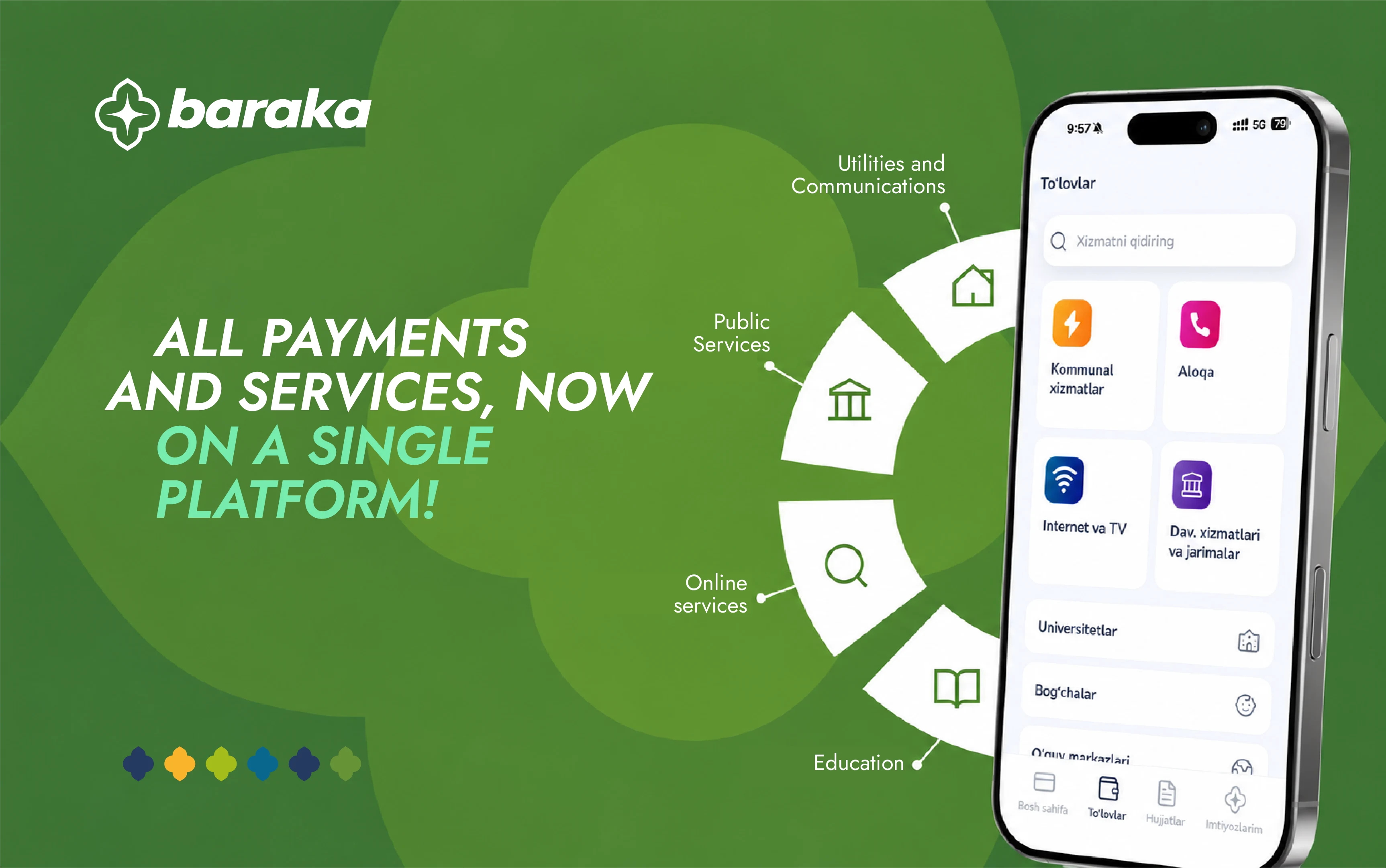
All Payments and Services, Now on a Single Platform!
Stop wasting time searching for separate apps for utilities, government fees, or education centers. From daily essentials to complex...
09.04.2026